
'We Stabbed These People in the Back and It Was Disgusting'J$P Instant Transcript! Michael Medved talks to Bill
O'Reilly.
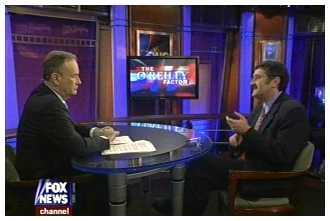 From The O'Reilly Factor, January 10 2005: BILL O'REILLY [FOX NEWS]: The culture war continues raging, and last night's People's Choice Awards is a good example of that. Michael Moore won for best motion picture, but Mel Gibson also won for bets dramatic motion picture. Do you think CBS, which broadcast the program, was hedging its best a little here? Now it used to be the Gallup people tabulated the votes of the People's Choice in a scientific way. Now the whole thing is done on the internet, with the usual lobbying going on. Moore in particular urged his supporters to get out and vote for him. With us now, conservative talk show host and film critic Michael Medved, who used to be a liberal guy, who discusses this in his new book entitled Right Turns: Unconventional Lessons from a Controversial Life. All right, this People's Choice thing, I don't watch these dopey things, I don't care who wins. But this was so fabricated. People knew in advance who was going to win. It wasn't a scientific way to do it; I don't know what they did. How do you see it? MICHAEL MEDVED [AUTHOR]: First of all, I think what's so stupid about it is the way everybody is grouping together Michael Moore's movie and Mel Gibson's movie, as if they're somehow connected at the hip. And that's terribly, terribly unfair. The way all the coverage goes is two guys who both bucks the odds, with big crowd pleasers that made millions. Well, The Passion of the Christ made three times as much money, both domestically and worldwide, as Fahrenheit 9/11. And The Passion of the Christ is not a political film, and Michael Moore's movie is nakedly political. I think it's absolutely deeply insulting to the movie business and to all of those Americans who went out and saw The Passion and were inspired by it to compare it to Fahrenheit 9/11. And that's what I think is the main crime about this whole People's Choice thing, is that, well now we're balanced. We'll give Michael Moore something-- O'REILLY: Yeah, but I think rather than have the Gallup people go out and find--I believe The Incredibles would have won, I do, if you did a scientific poll. Or Shrek 2. But anyway, what do you think is going on here inside the mainstream media? You're a talk show host and you do that. But inside the CBSs, NBCs, ABCs, do they know there's a culture war raging and how are they handling it? MEDVED: Well they're beginning to. But part of the problem is they don't get the religiosity of the American people. And that's part of what I write about in my book, is part of my first awakening as a conservative movie critic, is noticing the way people would automatically praise any film that attacked, for instance, the Catholic Church. There was a film, years ago, called Agnes of God, and when I was reviewing that on Sneak Previews. I tell the story about how I said wait, this is getting kind of old now, all these movies attacking the Church. And all of a sudden I was getting all of these emails--well there weren't emails then, I was getting letters--and people were calling with support, including some priests and monsignors and for a Jewish kid, that was kind of an awakening. O'REILLY: Well the secular entertainment industry not only attacks Catholicism, but it attacks pretty much all religion. MEDVED: Absolutely, including the Orthodox Jewish religion. O'REILLY: You were, how liberal a guy were you? Were you far left? MEDVED: No, I worked for Bobby Kennedy. I was there and I tell the story about being there-- O'REILLY: So you were a liberal ideologue? MEDVED: Yeah I was. But a liberal Democrat. I was never a Stalinist of any kind. In Right Turns I tell the story about being, because I was working for Bobby Kennedy, I was there when he was shot. And I made a resolution after seeing the assassination that I would name my first son, when I had one, Robert Francis Kennedy Medved. Well my son's named Danny. I mean, I've changed. O'REILLY: What caused you to change? MEDVED: A lot of things, but mainly the recognition that in this world, everything worth defending depends on military power. I had sort of bought a lot of the assumptions of the peace movement, that you could go ahead and stop bad guys by putting daisies into the butts of their rifles. That doesn't work as well as a well-equipped tank battalion. There were two things that taught me that lesson. One was what happened at the end of VietNam. I'd been part of the anti-war movement. It was shameful that the anti-war movement, my colleagues in the VietNam Moratorium, were so silent when we betrayed our allies in VietNam, and we allowed the holocaust in Cambodia to happen, and we allowed the slaughter. And then the other thing, right at about the same time in 1973, just a few years before, the October war in Israel, where all of a sudden a few pieces of military equipment that were provided by Richard Nixon, who had never had that much support from American Jews, Richard Nixon provided the airlift that kept Israel alive, and that was very important to me. O'REILLY: Well you are pretty astute. I write in my column this week, it appeared today across the country in many newspapers, that McGovern criticized the Iraq War last week--last week--and said well now VietNamese are our trading partners. 900,000 people were put in concentration camps by the North VietNamese when they overran the south. And as you pointed out, 2,000,000 Cambodians were slaughtered by the Communist Pol Pot government. Yet you didn't hear a word from Jane Fonda. MEDVED: Nothing. O'REILLY: But you picked it up, but most of your colleagues did not. MEDVED: Well I'll tell you how bad it was. I was on the VietNam Moratorium steering committee, and I actually tried, in April of 1975, when all of this was going down in VietNam, and there were a million refugees, and it was heartbreaking. You could see-- O'REILLY: Yeah, they were in Hong Kong, they were coming here, they were-- MEDVED: Well they were running in the face of this onrushing North VietNamese army. And we had signed a treaty in the Paris Accords that said if that happened, we would go in and protect our allies. We didn't. We stabbed these people in the back and it was disgusting. And I tried to get some of the other people I knew from the anti-war movement to say something. No one would say anything. O'REILLY: Why? Why wouldn't they say anything? MEDVED: They said, they said, and I talked to a number of people, these are CIA scare stories. These people are collaborators with the Americans; they deserve to die. There's a story, and I talk about it in the book, of literally, from Saigon, there were people who were killing themselves, taking poison, so that their children would be taken out as orphans by the Americans and would have some chance at a decent life. O'REILLY: So you changed in the mid-70s, and very few others did. MEDVED: Yes. O'REILLY: Now where are you now? Are you a committed conservative? MEDVED: I am a very committed conservative. I am an outspoken Republican. I'm a card-carrying Republican, if there is such a thing. But I'm also-- O'REILLY: Do you get criticized by other Jewish people-- MEDVED: Are you kidding? All the time. O'REILLY: --because 75% of American Jews voted for Kerry. MEDVED: Yes, but we at least did better than we did in the year 2000. We went from 18% of Jews to 25% supporting President Bush. I make a point, there's a lot of talk about neocons. I'm not a neocon. I'm a theocon. Because for me, and I think this is true for many, many Americans, Catholic, Protestant, Jewish, my conservatism is directly related to my own growth religiously. I became more religious also starting in the mid-70s, and my conservative politics has gone along with that. Including conservative politics on the human life issue, where I think that's one where we really do need to do a better job explaining that position in favor of life to all Americans including people who-- O'REILLY: Well the Democratic Party is wrestling with that now. The final thing is, if we pull out of Iraq, we're going to have the same thing that happened in VietNam. You're going to have a mass slaughter in that country, and that's another thing to consider. MEDVED: We are indeed. And again, I don't think that the Iraq-VietNam comparisons have ever been that fair. But that comparison is terribly fair. And look, what happened in VietNam was the darkest moment in American history. Paul Johnson, a great British historian, says so. We've been such a great country, we've made such a good difference for everybody, that was shameful. O'REILLY: All right, Michael Medved, the book is Right Turns; we appreciate your coming on in. We hope it's a big success. Thank you. MEDVED: Thank you. posted: Tue - January 11, 2005 at 01:45 AM j$p send Tom Paine Who provided this transcript? It is not accurate. January 11, 2005, 1:28:16 PM EST – Like – Reply johnny dollar How so? January 11, 2005, 1:44:43 PM EST – Like – Reply Rubin I was about 12 in 1960..and remember the presidential campaign. My folks and family were Democrats including myself, But by 1970 I became fed up with the D. party and changed registration. Looks like Michael Medved changed too along with whole lot of us. People's Choice: Michael Moore, I'd vote for him too......to spend eternity looking for a cold spot in Hell. January 13, 2005, 9:48:01 AM EST – Like – Reply |
Quick Links
About johnnydollar.us
This site includes J$P posts from 2004-2007. For current posts please direct your attention to johnnydollar.us.
Contact Us
j$p categories
Search J$P
Archives
|

